I've been feeling really poorly this week - some kind of lurgy which has given me aches all over, a spinning headache and a very fluctuating temperature. This afternoon has been the first time I've felt almost human for a bit; most days I've been sleeping on and off as exhaustion took hold during the day. To add insult to injury, I also have the return of my tooth problems from last year, so am on Penicillin. This has the unpleasant side effect of making my morning cup of tea - and most other things for that matter - taste like earwax! Yuk.
Today should have been my next City and Guilds at Barbara's, but I felt too poorly to go. However, I've brightened enough to try out the beginnings of a little counterchange with scraps of fabric. This moves on from my repeating patterns last week, to using fabric and appliqué for pattern making. Counterchange is where the same image or motif is repeated in the reverse colours - in this case a lime green furnishing fabric (a remnant bin find from somewhere or other) and a rather nice deep maroon shot silk (a recycled charity shop shirt). Neither colour comes quite true in the picture, but they're rather hard to capture. Here I'm using the most simple form of counterchange, a chequerboard pattern of alternating squares.
I've switched the orientation of the deep red silk in each row, so that there's a subtle change in the tone of these squares, along with the more obvious contrasts between the red and lime green. Again, the photograph doesn't quite capture this. I intend using subtle running stitch to stitch the silk down and hope that the red squares don't fray too much; I've tried to strip away the warp and weft threads on the edges with masking tape, before pinning them down, but I guess there will be more bits to clear off by the time the stitching is done.
My happy place for all things stitch and textile. You can also find me in more musing mode, at "Of Gardens, Grandmothers and Gleanings"
Saturday, 13 April 2013
Friday, 5 April 2013
designing
I traced the shapes out on tracing paper, reducing the original images to simple outlines and shapes. Then I scanned the tracings into the PC and did some faffing about, tidying up and generally making the images clean, before filling some of the outlines to make a basic black an white image that I could manipulate by flipping, mirroring and otherwise playing around. There is a really good free programme that I use to do this called Paint.Net. Recommended to me by one of our techies at work, you can download it from here. It does all sorts of good things like layering, resizing, recolouring, transparency and has some interesting special effects.
Having done that I found I had some rather interesting images, a gathering of bottles
washing up looking a lot more interesting than it usually does
icicles transformed
vases starting to look rather architectural
flowing seedheads
and finally a pattern based on some tree bark I was looking at yesterday, not in black and white this time, as I wanted to play with colour and evoke the natural source of the image
I think this is my favourite at the moment, but I've started looking at more ways of repeating designs that aren't simple mirror images
Labels:
City and Guilds
Monday, 1 April 2013
stitchy update
I'm sorry, I have failed entirely to keep up with showing you what I've been doing for my City and Guilds. In part that's because I've been so busy doing something or other textiley, but also because I've not managed to take photos in natural light as it has been dark by the time I've got home from work and got what little brain I have in gear! So, time to make amends.

We've been concentrating on shape; doing design exercises where we take shapes and "explode" them by cutting them up and arranging the pieces to see how this distorts things. Playing with circles and squares, flipping, rotating, cutting in different patterns, or drawing patterns on the black paper with a silver pen, then cutting the paper and rearranging. I took one if the negative shapes left from cutting out a circle and pasted some uneven strips behind it. It reminds me of the moon seen through grass stems.
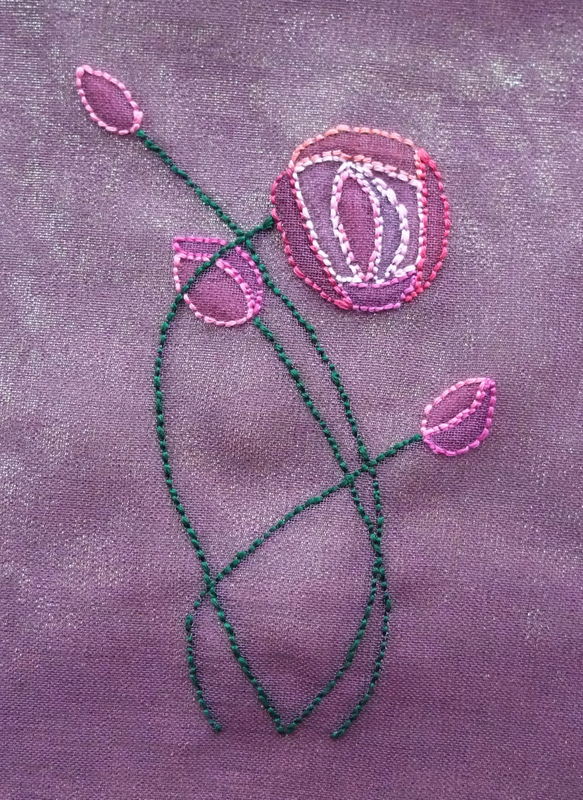
From shape, you get to shadow work; using sheer fabrics and strong coloured threads to outline a shape and have a softer colour in the center. You achieve this by stitching herringbone on the back of the design - the little back stitches that are created outline the shape, while the herringbone shows through to the front of the fabric because it is sheer. My first attempt was pretty shabby, so I shan't show you! I then thought I'd see what happened if I used a darker fabric with lighter threads to stitch with. Found a little design I did years ago based on Mackintosh's roses, and off I went.
I'm rather pleased with the result. I've backed it with gold cloth - you can see it shining through here, and will work two lines of close satin stitch with the machine, then cut back to the gold in between to create a frame. That will have to wait until the work has been assessed though, as we have to make the back available for inspection!
Then I did a bit more, this time combining shadow work, couching and Point Turc and Paris Stitch. Instructions for both of these can be found here. Both stitches leave fine holes in the fabric, where as you stitch, you pull the thread tight to draw the threads of the fabric together. You often see them on fine lacy handkerchiefs or baby clothes and they are used to either applique one fine fabric to another, or as a decorative hem. I've used them here to attach the strips of fabric in the top half, to stitch round the "sun" in the center and at the horizon line. On the lower half of the design I've worked the herringbone stitch on the surface of the fabric this time, to represent waves - along with some threads couched down and some that are slotted between two rows of stitches so they lie between the layers of sheer muslin with the colour showing through. There are 9 waves; I had in mind the Irish legend of the Isles of the Blessed, which lie beyond the ninth wave. If you click on the photo to enlarge, you might be able to see the sprinkle of fairy dust just below the horizon!
Next we had a session on machine embroidery. If you're following, you'll have seen the work I did at Wendy Dolan's class. I'll be using this as one example, but I also did a little picture combining layering organza and machine embroidery. This came from my watching the fields go by on my recent trips up to London. There was a lovely haze in the air on both days, and the landscape layered away into the distance with trees silhouetted in the moist, chill air. You'll notice a similarity of colour between this and the Ninth Wave piece - I only have so many bits of blue organza to choose from. I used Mistyfuse to attach the organza to the base fabric to stop it fraying at the edges; it does make the fabric a bit stiff to handle, which is fine for machine embroidery, but which might be annoying if you were hand stitching. I'll have to experiment! I'm not sure the colours of the stitching work quite the way I intended, but it was an trial and I'm pleased with the way it turned out. You can't see the shimmer of the organza in this picture, but as the light catches it at different angles it shimmers.
I also did another piece of machine stitching, using the nine patch again as a the basis for the design. I like the way it is both regular and uneven, working with the number three, which is symbolic in many human cultures. It also allows one to work variations on a theme, this time using rows of straight stitching and vermicelli stitch for the outer squares and granite stitch in the center. I combined single and multi-coloured threads to see what the effect is of using each. Again, I'm pleased with the results, though they are still very amateur; I found the most important thing to remember was to breathe! You also find that as you tense up when trying to control your wayward hands, the patterns tend to stray and the machine gets faster and faster as your foot presses down on the foot pedal! I used a neutral variegated thread to outline the squares and give definition to the image.
I would like to combine this with organzas underneath, it might create some quite lovely effects - I'm thinking of something based on Moorish tilework, where the regularity of the pattern would allow the sheen and sparkle of the organza to shine.
Oh for more hours in the day!
I'm rather pleased with the result. I've backed it with gold cloth - you can see it shining through here, and will work two lines of close satin stitch with the machine, then cut back to the gold in between to create a frame. That will have to wait until the work has been assessed though, as we have to make the back available for inspection!
Then I did a bit more, this time combining shadow work, couching and Point Turc and Paris Stitch. Instructions for both of these can be found here. Both stitches leave fine holes in the fabric, where as you stitch, you pull the thread tight to draw the threads of the fabric together. You often see them on fine lacy handkerchiefs or baby clothes and they are used to either applique one fine fabric to another, or as a decorative hem. I've used them here to attach the strips of fabric in the top half, to stitch round the "sun" in the center and at the horizon line. On the lower half of the design I've worked the herringbone stitch on the surface of the fabric this time, to represent waves - along with some threads couched down and some that are slotted between two rows of stitches so they lie between the layers of sheer muslin with the colour showing through. There are 9 waves; I had in mind the Irish legend of the Isles of the Blessed, which lie beyond the ninth wave. If you click on the photo to enlarge, you might be able to see the sprinkle of fairy dust just below the horizon!
Next we had a session on machine embroidery. If you're following, you'll have seen the work I did at Wendy Dolan's class. I'll be using this as one example, but I also did a little picture combining layering organza and machine embroidery. This came from my watching the fields go by on my recent trips up to London. There was a lovely haze in the air on both days, and the landscape layered away into the distance with trees silhouetted in the moist, chill air. You'll notice a similarity of colour between this and the Ninth Wave piece - I only have so many bits of blue organza to choose from. I used Mistyfuse to attach the organza to the base fabric to stop it fraying at the edges; it does make the fabric a bit stiff to handle, which is fine for machine embroidery, but which might be annoying if you were hand stitching. I'll have to experiment! I'm not sure the colours of the stitching work quite the way I intended, but it was an trial and I'm pleased with the way it turned out. You can't see the shimmer of the organza in this picture, but as the light catches it at different angles it shimmers.
I also did another piece of machine stitching, using the nine patch again as a the basis for the design. I like the way it is both regular and uneven, working with the number three, which is symbolic in many human cultures. It also allows one to work variations on a theme, this time using rows of straight stitching and vermicelli stitch for the outer squares and granite stitch in the center. I combined single and multi-coloured threads to see what the effect is of using each. Again, I'm pleased with the results, though they are still very amateur; I found the most important thing to remember was to breathe! You also find that as you tense up when trying to control your wayward hands, the patterns tend to stray and the machine gets faster and faster as your foot presses down on the foot pedal! I used a neutral variegated thread to outline the squares and give definition to the image.
I would like to combine this with organzas underneath, it might create some quite lovely effects - I'm thinking of something based on Moorish tilework, where the regularity of the pattern would allow the sheen and sparkle of the organza to shine.
Oh for more hours in the day!
Saturday, 23 March 2013
WEFT exhibition
I've been having a bit of a textiley time recently. I treated myself to a trip to the spring knitting and stitching show at Olympia last weekend, from which I returned with some fabric and stitch treasures - organza, silk, threads - you know what happens when temptation strikes. Then today, because it was the penultimate day, I went to the World Eco Fibre Textile show at the Brunei Gallery. It was quite marvelous, with textiles of all sorts to thrill and inspire; so much in fact, that I don't know what to include and what to leave out! I made the mistake of not photographing the little information board for each of the pieces I took pictures of, and only had my mobile phone so the quality isn't that great, but here are some highlights. I've included links where I can so you can follow up the artists if you're interested to do so.
There were some wonderful silk embroideries from Suzhou, and three delightful "embroidery ladies" who were showing the way these astonishing embroidered picture were created. The silk thread that is used for the stitching is so fine that it looks like spiders web and they use it to stitch images that, even from quite close up, look more like finely done paintings than something stitched. I had to resort to the short sighted trick of taking my glasses off and peering so close that my nose almost touched the pictures (being careful to not even breathe!) to see the stitching.
This is Winding, by Zou Yingzi, a work based on her own photograph,
then the beautifully named Sorrow of the Lotus, a triptych hung as three scrolls, the detail gives you some idea of the fineness of the stitching, but actually the phone camera couldn't begin to capture it. She is the lady in the red scarf below; you can also see another of her embroideries in the background of the picture, and the image of a panda that she was working on while we watched.


These pieces were all in the first room; you then wandered under a canopy of sheer embroidered fabric, and down the stairs, lined with more fabrics - this time batiks from Indonesia and at the bottom, some lovely mulberry fibre hangings and indigo shibori. Particularly delightful was the rippling texture of the stitched shibori, but sadly, can't remember where it was from


Then into the lower room, which was hung with all manner of delights. I made very few notes here, just sat and gazed, wandered about and gazed some more, slipped in between slivers of dyed silk wafting in the draft of my moving, marveled at the variety of textures in a pair of wall hangings and generally felt that I wished I had the strength and time to spend all day just looking! There really was so much to explore, wondering how this pattern was created, what dyes were used for that colour, delighting in the subtlety of shading in the eco and rust dyed silks that shimmered at the slightest movement of air. it was impossible to capture the delicacy, the sheen, the transparency of some of the textiles on show, in fact, pointless to even try; the beauty was in being there, moving in and out, to and fro, from one piece of cloth to the next, comparing, contrasting, absorbing as much as possible.


I loved "Shroud of Ancient Echoes by Susan Fell McLean, such an evocative name for a beautiful piece of cloth tie dyed, patterned, stitched and patched. You can read a bit more about this here. It was hung to the right of a beautiful pieced silk shawl by Olivia Batchelder, which I just longed to stroke, it was so lovely, both in its colours and textures.


This lovely indigo shibori hanging Tree of Life was produced by artists from the Aranya Natural Dye Unit, an enterprise that provides a way for physically challenged young people from a tea estate in Kerala. Unable to work on the tea estate, they create beautiful pieces of shibori dyed textile that are made into scarves that you can by online here
I loved the complex textures and colours in these two hangings, but again didn't make a note of who and where.

There were yet more shining silk embroideries on this level. Summer Lotus, buy Liang Zuefang - you can see her working on the exquisite piece here, watch the way the thread just floats on the air as she draws it from the bundle to start a fresh colour.
Also her monochrome piece, Lotus Rhyme, which can be viewed from both sides and is a marvel of delicacy of stitch. Again, I had to get right up close to it to even see the stitches, the thread so fine that it disappears the minute you move more than a few inches from the piece.
Finally Sun and Moon - mixed media pieces using bark cloth by Ramsay Ong of Malaysia
Some delicious shibori tied dimples of red and orange and indigo


a view of some of the many pieces of woven, embroidered and dyed cloth from around the world
and two lovely simple hanging that were the first things I saw as I entered the exhibition, delicately coloured, with simple repeating patterns, the beauty all in the combination of colours and textures.
All in all, a really enjoyable day out, I was really glad I found time to go.
There were some wonderful silk embroideries from Suzhou, and three delightful "embroidery ladies" who were showing the way these astonishing embroidered picture were created. The silk thread that is used for the stitching is so fine that it looks like spiders web and they use it to stitch images that, even from quite close up, look more like finely done paintings than something stitched. I had to resort to the short sighted trick of taking my glasses off and peering so close that my nose almost touched the pictures (being careful to not even breathe!) to see the stitching.
This is Winding, by Zou Yingzi, a work based on her own photograph,then the beautifully named Sorrow of the Lotus, a triptych hung as three scrolls, the detail gives you some idea of the fineness of the stitching, but actually the phone camera couldn't begin to capture it. She is the lady in the red scarf below; you can also see another of her embroideries in the background of the picture, and the image of a panda that she was working on while we watched.


![]() |
| Traditional backstrap loom |
![]() |
| Ikat weaving |
There was some beautiful Ikat weaving from Malaysia - I loved the comment on the information board
"when the Iban traditional weaver creates her piece of pua-kumbuku or warp ikat textile, it is the belief that she is divinely inspired through dreams to create the motifs. Her weavings are like woven dreams created out of the cotton threads, spun from the cotton that she grows".
You can read more about this tradition, one of learning from the goddesses of weaving here.
These pieces were all in the first room; you then wandered under a canopy of sheer embroidered fabric, and down the stairs, lined with more fabrics - this time batiks from Indonesia and at the bottom, some lovely mulberry fibre hangings and indigo shibori. Particularly delightful was the rippling texture of the stitched shibori, but sadly, can't remember where it was from


Then into the lower room, which was hung with all manner of delights. I made very few notes here, just sat and gazed, wandered about and gazed some more, slipped in between slivers of dyed silk wafting in the draft of my moving, marveled at the variety of textures in a pair of wall hangings and generally felt that I wished I had the strength and time to spend all day just looking! There really was so much to explore, wondering how this pattern was created, what dyes were used for that colour, delighting in the subtlety of shading in the eco and rust dyed silks that shimmered at the slightest movement of air. it was impossible to capture the delicacy, the sheen, the transparency of some of the textiles on show, in fact, pointless to even try; the beauty was in being there, moving in and out, to and fro, from one piece of cloth to the next, comparing, contrasting, absorbing as much as possible.


![]() |
| Shroud of Ancient Echoes 2 - Susan Fell McLean detail |


This lovely indigo shibori hanging Tree of Life was produced by artists from the Aranya Natural Dye Unit, an enterprise that provides a way for physically challenged young people from a tea estate in Kerala. Unable to work on the tea estate, they create beautiful pieces of shibori dyed textile that are made into scarves that you can by online here
I loved the complex textures and colours in these two hangings, but again didn't make a note of who and where.
![]() |
| Summer Lotus |

There were yet more shining silk embroideries on this level. Summer Lotus, buy Liang Zuefang - you can see her working on the exquisite piece here, watch the way the thread just floats on the air as she draws it from the bundle to start a fresh colour.
Also her monochrome piece, Lotus Rhyme, which can be viewed from both sides and is a marvel of delicacy of stitch. Again, I had to get right up close to it to even see the stitches, the thread so fine that it disappears the minute you move more than a few inches from the piece.
![]() |
| Lotus Rhyme |
![]() |
| Lotus Rhyme - detail |
Some delicious shibori tied dimples of red and orange and indigo


a view of some of the many pieces of woven, embroidered and dyed cloth from around the world
and two lovely simple hanging that were the first things I saw as I entered the exhibition, delicately coloured, with simple repeating patterns, the beauty all in the combination of colours and textures.
All in all, a really enjoyable day out, I was really glad I found time to go.
Labels:
applique,
embroidery,
memory
Saturday, 9 March 2013
stitching
I've had a post about my textile adventures in draft for I don't know how long, but I seem to be too busy, or too tired to get it finished and posted! It's all about the bits of dyeing I've been doing, but I've done so much more since I drafted it that I can't face the updates!! However, in the realm of stitch I had another lovely workshop with the Embroiderer's Guild last weekend. This time with Wendy Dolan, who's work I really admire. It was a workshop in using architectural details as a source for stitching. We were instructed to bring some simple images to work from and a variety of toning fabrics and threads.
I took along a variety of photos, or rather prints of photos. Once we'd been shown some of Wendy's work and understood the way the embroidery was to be achieved, I selected this image - which I took back in the days of wet film photography - or at least, before I could afford digital. It is from a brief and much needed break in Oxford in the late winter of 2001.
The image is a window in Christ Church College, one of the many beautiful buildings that grace Oxford. I walked past it several times on my way to the Botanic Gardens, a glorious place for peaceful contemplation. I loved the way the stems and branches of the climbers seemed so intertwined with the building's character that they appeared to be somehow part of it, rather than an addition from Nature's bounty.
I had selected a variety of salvaged fabrics from one of my many rummages through remnant bins in various shops over the years. They were all soft furnishing fabrics, and I selected ones that seemed to chime with the idea of old buildings. A mixture of natural and synthetic fibers and various textures, as I recall they came from a lovely little shop called Fabric Design in Matlock Bath. I visit them each year as we break our journey to the Lakes, and always come away with a bag of remnant goodies!
The workshop was fascinating - it's always a pleasure to see an expert at work; makes one realise how much faffing about and stopping and starting is involved when you don't know what you are doing. The technique involved tracing off the main lines of the image; using the tracing to arrange small blocks of fabric roughly under the tracing paper and onto the foundation fabric, positioning the bits with regard to the image, but in a loose, abstract fashion. We then transfered the traced lines, in reverse onto some stitch and tear or heavyweight vilene, placed that on the back of the design (having stitched all the bits down first) and stitched the first draft, as it were, from the back. The the bobbin thread outlined the design. then we turned the fabric over and began to work up the design from the front. All very scary to a beginner, but seeing Wendy's finished embroideries showed what can be achieved.
This is my resulting embroidery so far - all machine stitched and not yet finished to my satisfaction, but a brave effort! I'm conscious that it all looks a bit crooked, especially when I see it like this, rather than in the flesh, but it pleases me and I'm very aware that I am a very beginner when it comes to machine embroidery. I shall probably stitch more, but not too much more as I don't want to overwork it. I'll certainly try another one now I understand the way it is done.
In the meantime, I'm also making a sketch book cover using some of the fabrics from my Studio11 experiments. We have a sketchbook project for City and Guilds this summer so I bought a sketchbook specifically for this - it seems fitting for it to have a cover made from fabrics dyed and embroidered by me. I'm half way through, and will post the finished results, hopefully before Monday when I go for my next class.
I took along a variety of photos, or rather prints of photos. Once we'd been shown some of Wendy's work and understood the way the embroidery was to be achieved, I selected this image - which I took back in the days of wet film photography - or at least, before I could afford digital. It is from a brief and much needed break in Oxford in the late winter of 2001.
The image is a window in Christ Church College, one of the many beautiful buildings that grace Oxford. I walked past it several times on my way to the Botanic Gardens, a glorious place for peaceful contemplation. I loved the way the stems and branches of the climbers seemed so intertwined with the building's character that they appeared to be somehow part of it, rather than an addition from Nature's bounty.
I had selected a variety of salvaged fabrics from one of my many rummages through remnant bins in various shops over the years. They were all soft furnishing fabrics, and I selected ones that seemed to chime with the idea of old buildings. A mixture of natural and synthetic fibers and various textures, as I recall they came from a lovely little shop called Fabric Design in Matlock Bath. I visit them each year as we break our journey to the Lakes, and always come away with a bag of remnant goodies!
The workshop was fascinating - it's always a pleasure to see an expert at work; makes one realise how much faffing about and stopping and starting is involved when you don't know what you are doing. The technique involved tracing off the main lines of the image; using the tracing to arrange small blocks of fabric roughly under the tracing paper and onto the foundation fabric, positioning the bits with regard to the image, but in a loose, abstract fashion. We then transfered the traced lines, in reverse onto some stitch and tear or heavyweight vilene, placed that on the back of the design (having stitched all the bits down first) and stitched the first draft, as it were, from the back. The the bobbin thread outlined the design. then we turned the fabric over and began to work up the design from the front. All very scary to a beginner, but seeing Wendy's finished embroideries showed what can be achieved.
This is my resulting embroidery so far - all machine stitched and not yet finished to my satisfaction, but a brave effort! I'm conscious that it all looks a bit crooked, especially when I see it like this, rather than in the flesh, but it pleases me and I'm very aware that I am a very beginner when it comes to machine embroidery. I shall probably stitch more, but not too much more as I don't want to overwork it. I'll certainly try another one now I understand the way it is done.
In the meantime, I'm also making a sketch book cover using some of the fabrics from my Studio11 experiments. We have a sketchbook project for City and Guilds this summer so I bought a sketchbook specifically for this - it seems fitting for it to have a cover made from fabrics dyed and embroidered by me. I'm half way through, and will post the finished results, hopefully before Monday when I go for my next class.
Subscribe to:
Posts (Atom)