Thursday, 28 April 2016

Inspired by the EG

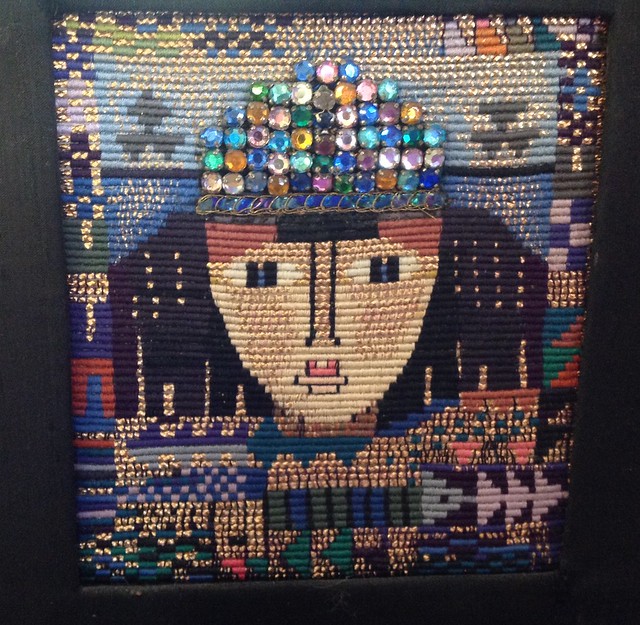
I have been neglecting this little space in the blogosphere because I have been rather busy. We've had several good sessions at the branch of the Embroiderers Guild that I belong to; another of our mini workshops, this time my choice was ribbonwork, but I've not done enough finishing to share with you here yet. We also had a marvellous talk by Anthea Godfrey about the work of her mother, Margaret Nicholson. It was so interesting to hear about someone who forged her own path at a time when women were still expected to stay at home and look after their families. Anthea brought an utterly inspiring set of her mothers embroideries for us to see.

Margaret used a wide variety of embroidery and beadwork techniques, employing all sorts of materials and methods. She particularly enjoyed Or Nue which is a goldwork technique which involves laying metal thread on the surface of the fabric and attaching it with embroidery silks in such a way that the stitching, using different colours, creates a picture which sparkles and glimmers in the light. It is a very old technique; a great speciality in this country during the 14th and 15th Centuries, when it formed part of the repertoire of English embroidery, known as Opus Anglicanum, or English Work. You can see examples in the V&A and we exported embroideries across Europe, often to religious foundations or churches, as the Church was a major patron of the arts then.

Margaret took this technique, combined it with others and, with her wonderful talent for design, created beautiful images full of imagination and colour as you can see here. 
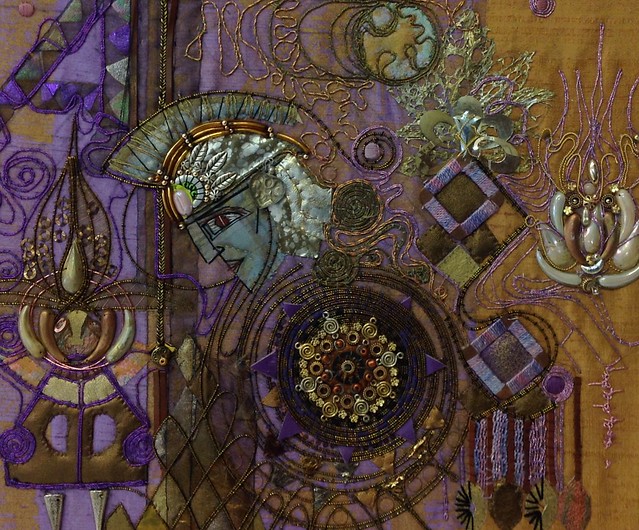


Anthea brought so many pieces that we could have spent all day just looking at one or two; the technique is so fine, and so labour intensive, it seemed miraculous that one woman could create so many beautiful embroideries in a single lifetime.

After such an inspiring talk I came home full of fire to get on with another Guild project, our regional challenge which we have every year. The theme this year is "Inspired by Royal Jewels" and the branch are busy creating all sorts of bits of embroidery to display at the annual Regional Day. I had a good look at royal jewellery and found myself rather uninspired, until I thought of the Alfred Jewel which is held in the Ashmolean (always a place to spend many happy hours!). This took me to the Anglo Saxons, and I discovered this rather lovely brooch found at the burial site of an Anglo Saxon princess in Kent. 


That seemed pretty royal to me, and much more inspiring than tiaras and diamond necklaces, so off I went. Drawing on the techniques I learnt at our Wendy Dolan workshop last year, I decided to create a cuff or bracelet based on the design of the brooch. Much trialling and stitching later, and I'm really rather pleased with the result - if you'll excuse the "old dear wrinkles"!!
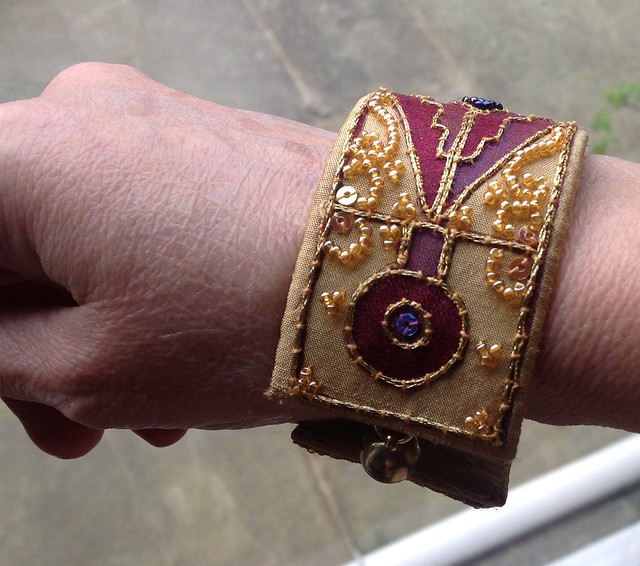
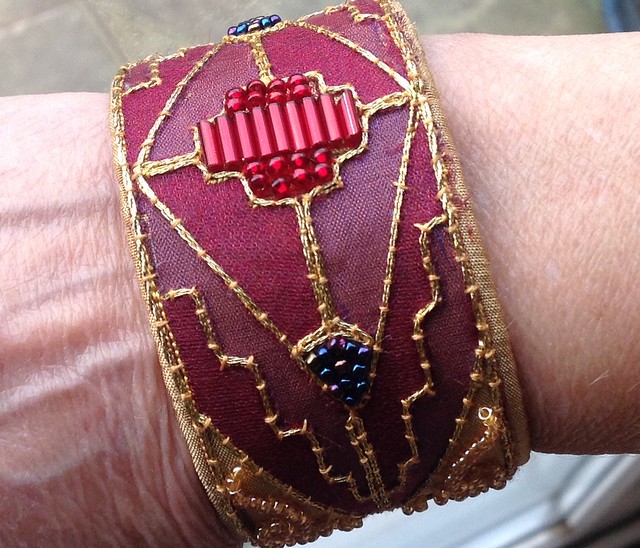


Goldwork, beads and layered organza cut back with a soldering iron to emulate the cloisonne technique of the original.

I just might see if I can do something else now.

Friday, 18 March 2016

Homage update

No, I haven't stopped stitching on this, but other things have been taking precedence, like learning all about colour and dyes!

Here is where I am so far. The three maple leaves all stitched around now, some spirals


and some little seeds floating down.


I will add more of these as I like the floatiness of them. As ever, forgive me for the blurriness of iPad images - I can't work out how to improve, though I'm sure there must be something in the settings I can change!


I'm happy with how things are going but, as with all projects like this, the further along I get the more worried I am that I'm going to mess it up with the next thing I do. While I was away learning about colour I did a little trial with two types of thread, to see if I could stitch some maple seeds to tie in with the leaves.


Problem is, I love them both! Christine's very wise suggestion was that I scan the image in, cut out several and try them each to see how they look on the cloth. What a wise soul.

Saturday, 12 March 2016

Colour all week long

I had a delightful time the week before last at Committed to Cloth, experimenting with colour, enjoying the companionship of the rest of the group and learning from Leslie, who is endlessly generous with her advice and expertise. We all experimented with mixing colours, each from her own source of inspiration. These included pictures torn from magazines, photos of favourite garden flowers, views of much loved scenes, paintings, advertising images, all the colours of the rainbow and more.

Some images were delicate and muted, some vivid and bright, we all brought or own interests and personalities to the workshop. Throughout the week Leslie talked to us about colour and shared her own working practice, inspirations and knowledge. We learnt about cool and warm colours, about tone, contrast, mood, proportion and the way to use the colour wheel to understand what colours go with each other and how they react to one another.

The first day we spent working from just one image, taking two colours from it and attempting to mix each from the eight dye colours available to us. We mixed a base colour, then diluted it, then diluted the dilution, if you know what I mean. These three source colours, light, medium and dark, were then mixed, each with each to achieve a palette of fifteen colours, graded from light to dark, from pure to mixed. The resulting colours were applied in little squares to the pre soda'd cloth of our choice. The studio was awash with little pots of colour and samples pinnned up on the design walls or pinned to the benches as we all experimented to our hearts content.


We were encouraged to "document, document, document" as this is the only way to truly understand the process. We were also encouraged to "steal" from each other, though only in the spirit of knowledge sharing. So, at the end of the first day we each went round everyone's table, with little bits of cloth, and took colour samples from everyone else's families, making notes on the mixes as we went.


This way we all benefited from each other's experimentation and colour interest; those working with a soft muted palettes could have brilliant brights as well, those working with darks could find out about pastels. Oddly, three of us, including me, worked a range from purple to green, my source being the Mackintosh Descent of Night which I had taken with me.

In the following days we either mixed yet more colours, refined the ones we had already mixed, worked on creating imagery from those mixes or some or all of the above. By the end of the week the studio was full of colour samples and creative fabrics produced with our colours. In between these experiments we were fed delicious soups and salads, were tempted by several yummy cakes and a sumptuous cheesecake, had the opportunity to browse the books on the shelves in the studio and were given encouragement, help and advice from Leslie. We also had the pleasure of sharing each other's interests and expertise, and watching everyone's imagery and colour palettes develop through the week. With such a wide variety of experience and practice there was more inspiration than one couple possibly absorb in one week. Plenty of food for thought to mull over in slow time.

You can check out the C to C Facebook page for the results and some details of the lovely work produced. My own images were drawn in part from the pictures I took along for inspiration and in part from experimenting with the tools available in the studio. I became quite adept at applying colour with Leslie's favourite tool, a credit card, tried out some of the thermofaxes, made a thermofax of my own, experimented with brushes and a bit of monoprinting and used masking tape and a silk screen to blend a grid of colours from one of my experiments. All in all, a wonderful week of experiment, learning and laughter in in the company of like minded, creative, talented women.

Maksing tape screen in purple and gold

Monoprinted blues that I couldn't bear to waste

Thermofax umbellifers in greens and golds

Credit card drawn image loosely based on Eric Money's beautiful The Ferryman
layered work in progress from purple to green 

Thursday, 25 February 2016

Must try harder

as my teachers always said! I have been busy, just not astonishingly productive. We had teenagers to stay so the house had to be made ready, then it had to be made tidy again and unteenaged! Not that they were too bad bless them; they went to Hastings together and played Crazy Golf on the seafront - mad things. It's a regular ritual when they come and stay. Should I admit to never having played Crazy Golf?

I've been doing little bits of stitching here and there, mostly on the Homage Cloth and my breakdown printing piece which is finally coming together, albeit slowly. I won't post pictures today is it's getting dark outside and artificial light just doesn't pick up the colours properly. I will announce an adventure though. I have next week off work and am going to another workshop with Leslie Morgan at Committed to Cloth. Having worked my last work day today I can now begin to believe I'm having a holiday (life is stressful in the world of libraries just now!)

So, this is what I'll be doing next week, every day. Won't that be fun? I've got some fabric to take with me - 3 metres of cotton poplin, and will buy some of Leslie's lovely cotton sateen while I'm there; it takes colour so very well. Even better, one of my friends from Studio 11 is coming too, so we can swap notes and report back at our next session there.

We've been advised to take some picture inspirations along, so I've put together some images to work with:

Klee - just love the colours here and the way this looks like a quilt. I'm taking another image of his as well for contrast


Charles Rennie Mackintosh - Harvest Moon, my favourite of his, though I've also printed out the lovely Descent Of Night


Jan Myers Newbury, whose shibori pieces are just so amazing


and Paul Nash, whose wonderful sense of mystery and the indwelling spirit of landscape has always thrilled me - though this (Landscape of the Vernal Equinox) might be a bit too gentle for the colour exercises


Hopefully these, and the other six images I'm bringing, including the beautiful Incantation Under a Winter Sun by Rima Staines, will provide plenty of inspiration. I will come home with lots of colour samples like those I did with Michel Garcia, some solid colours, some surface design pieces and a much deeper understanding of how Procion MX dyes can be mixed to get the colours I want.

I do love this dabbling in textiles - what more could you want but colour and texture all together.

Just don't ask me "what are you going to do with all the fabrics" - a common query .... I refer you to my opening statement!

Saturday, 30 January 2016

Quietly continuing

There's still a lot to be done on this, but I'm slowly finding my way along, taking each section at a time and seeing where it leads me next.

As I haven't posted about this for a while, here are a couple of close ups


and the whole piece in natural light


I love the delicate turquoise and the way it interacts with the eco colour. I'm aware that those leaf prints may well fade with time, so am accenting them with stitch. I think there may be some floating seeds scattered about at some stage, it has a feeling of Autumn about it. Hardly surprising considering when I started.

I haven't decided on a border yet, I'm waiting to see where I get to with the stitching first, feeling for what the cloth is telling me as I stitch it. Truly a slow stitch project.

Sunday, 24 January 2016

Blackwork with a bit of red

Here's the finished piece: yes, something finished! Pam's design was a pleasure to work and she supplied us with a couple of pages of filling patterns to choose from, so each piece will be unique. One of the things I discovered, having a couple of books on the subject, was that these are almost infinite; just take a grid and join up the dots one way or another, any way you can think of, and repeat. It's a testament to our very human delight in pattern making and complexity.


I stuck to Pam's suggestion of working a differing weight of filling for each section, but didn't use my variegated thread in the end, it was a little too thick and would have looked unbalanced against the outline. I did use red though, which is always the first colour one thinks of with roses and this is a sort of rose. I've used two closely allied reds to reflect the way the colour of rose petals is sometimes shaded from centre to tip. I'm really happy with the result though, no, I'm NOT going to show you the back!

Hope you like it.

Wednesday, 20 January 2016

A very enjoyable interlude

Our Embroiderer's Guild Branch is a select group of talented women. There aren't very many of us compared to some branches in the south, but we do have some great embroiderers. This year as part of our programme we are running a series of mini workshops where three brave members have undertaken to teach the rest of us a technique that they feel they are good at, or love to do. So we have the option of Blackwork, Silk Shading and Ribbonwork over the coming months. The plan is to spend a Saturday afternoon happily stitching under the watchful eye and tutelage of our lovely experts. This Saturday I was reminded what a pleasure Blackwork is as one of our members, having designed a pattern and put together a little pack for each of us, sat us down and told us a bit about the history and helped us to get started. You may remember I did this in my City and Guilds back in 2012; the chance to revisit the technique was not to be missed.

A little bit of history. Blackwork was very popular in the Tudor court, having reputedly come across from Spain with Catherine of Aragon and was known then as Spanish Work. Initially always worked in black silk or cotton, often on even weave cloth. Here the patterns are created by the counted thread method, so working the stitches according to the number of threads stitched over or under. There are a variety of stitches used; one method using a running stitch, which is then worked back in the opposite direction, became known as Holbein Stitch because it appeared so often on the collars and cuffs of Holbein's court paintings. It is particularly clever as it looks the same from the back as the front and so was worked on the edges of garments where it would be seen on both sides. Some Blackwork is not counted thread, examples include pillow covers or coifs and caps worked in fantastical designs of plants and animals. Since then it has gone in and out of fashion and modern Blackwork would be unrecognisable to the original practitioners. One of the beauties of the stitch is the way you can create the most marvellous light and shade effects by both working with threads of different thicknesses and by fragmenting the stitching patterns so they appear to fade out. There are some wonderful examples on the Royal School of Needlework's page here,


So here are my efforts so far, the outlining done and the filling in to be started (whispers ... "don't ask why one of the acorns is wearing a hat"!). Such a pleasure to sit and stitch with a group of friends and share our enjoyment of embroidery. I am thinking of departing from tradition by working the acorn cups in a mid brown and the centre rose in red, possibly even a variegated thread as I do have some treasures I want to try.

So thank you Pam for providing us with such a lovely design, and for getting us started, I'll do my best to do it justice, and get it finished by the next workshop so your fresh band of students can see what is possible.