Saturday, 27 April 2024

Edgelands from Prism

Yesterday I had the pleasure of going to Prism’s latest exhibition “Edgelands” at the Art Pavilion, Mile End, London. My primary motivation was to see the richly embroidered, landscape inspired textiles by Kim McCormack and I was very fortunate in that she was welcoming folk to the exhibition at the desk when I arrived. She was such an interesting person to talk to and kindly indulgent of my effusive praise. I saved her works until the very end as I wanted time to focus on them. There were plenty of other artworks that caught my attention as well, as did the exhibition space. It is a wonderful, glass fronted, long curving gallery with a lake to one side which throws rippling shafts of light onto the ceiling, providing an extra sense of magic to enhance the works exhibited there.


What did I enjoy?

Sue Reddish’s masterful use of repurposed clothing to create her pieces about the liminal spaces around and beneath the two miles of the elevated Mancunian Way, which has cut across the city since the 1960s. Her tiny seed stitch in a rich orange in this piece creates a haze of colour as though the background, which I read as sky, was flowing forwards across the land.


In Judith Isaac-Lewis’s wonderful collection of "Nature Pages" botanical prints, made with plants collected from the former railway embankments at St Alban's Way, were enhanced with the most evocative embroideries. I loved each one for the way she used a small selection of stitches which spoke to the natural imagery.


Jane Riley’s tapestry, "The Fortress Cliffs" was inspired by the cliffs at Ravenscar North Yorkshire. I thought her use of differing textures of thread and eccentric weave created a real sense of standing at the edge, looking out, and expressed her hope for the continuing recovery of this space from its industrial past.


The delicate glimmering of Jill Walker's honesty seeds, suspended and swaying with every passing movement of air was beautiful to behold, and touched me deeply, reminding me of how I fell in love with these “paper pennies” as a child.


The snapshot views in Amanda’s Hislop’s five wall hangings and concertina book perfectly evoked her experience of snatched views and changing seasons while walking in farmland near her home.


Marian Jazmik’s incredibly delicate monochrome pieces using a wide variety of reclaimed materials astonished me. The amount of work it must have taken to produce them was one source of amazement, quickly followed by admiration for her inventive use of mundane objects such as zips to evoke elements of the natural world and of decay which were inspired by her own photographs.


Niki Chandler’s symphony of shining colour was a wonder to behold. Built from multiple layers of fine netting, used for dance costumes, she created a patchwork of square shapes, blending colours carefully by folding and layering her net to construct a dance of changing colour across the dark background.


Anita Bruce's linked woven hangings were inspired by the patchwork patterns of familiar farmlands as they appear on satellite images. Initially she was considering the luxuriant verges she drove past, and their contrast with the unvaried canvas of the fields. When heavy rain flooded the area those fields disappeared; a visual reversal where patches of farmland become small islands in a vast, sky reflecting, lake.


Helen MacRitchie’s pieces are meditations on the way that nature reclaims urban spaces and margins as they become more neglected. Two wall hung artworks contrasted strong green twining strands with underlying patterns evoking urban space. 


A freestanding work, suspended from the ceiling, took the contrast of these geometric and organic elements and liberated them into space where one could walk round them and consider from all angles the way nature was inserting herself into the built environment. Glimpses of the outside environment, mixed urban and natural, brought those contrasts to life.


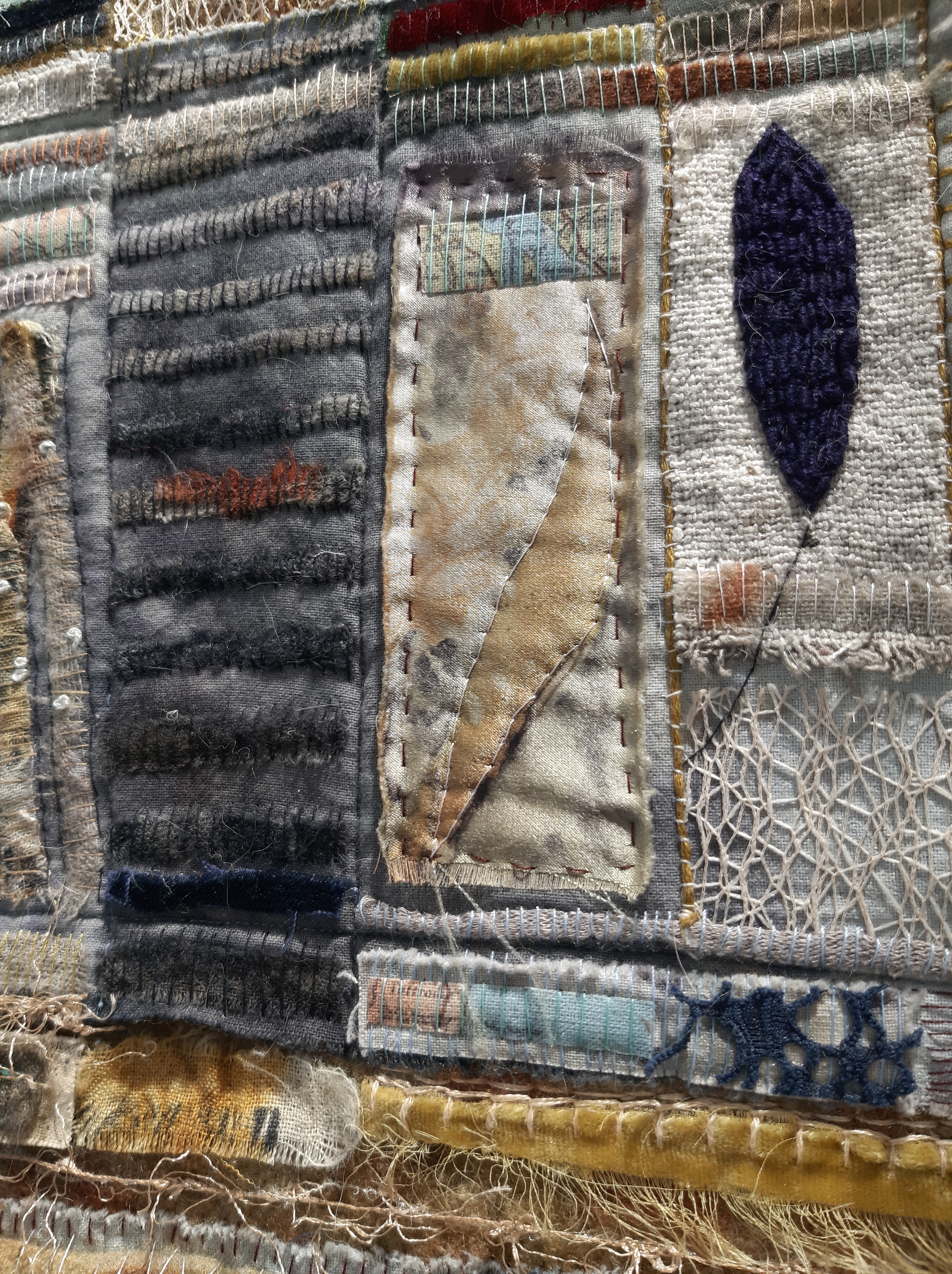
And finally, having saved them until last, I gave myself up to enjoying Kim McCormack’s wonderful eco print embroideries, The Wet Desert, A Trail to Glenurquhart and The Rewilding. She combines so many elements and textures: silky surfaces with tactile velvets; fragments of map with the leafy shapes of eco printing; dense areas of bullion and French knots contrasted with delicate lines of stitch which connect everything together. It was such a pleasure to see them up close, to look carefully at the layering and overlaying of different elements: couched down tubes of soft wool; leafy shapes and patterns creating a counterpoint with more geometrical areas; hand stitch and machine stitch. I marveled at the many hours of planning and stitching that must have gone into making each piece. I loved the way some of the botanical prints disappeared behind the next layer, giving a sense that all was grounded in the natural world. All in all a very inspiring day out




If you would like to know more about what was exhibited there you can download the exhibition catalogue from the Prism website here. It's well worth a browse and the site also has links to all of their members

Thursday, 14 March 2024

Honouring Christine

 I'm sorry for my recent silence. it has been a busy several months and I always find that winter saps my creative energy. In the intervening time I have been involved with a group of Studio 11 folk, all of whom are missing Christine, the Studio and that sense of fellowship which came with it. She truly achieved what she set out to do all those years ago.

We felt we would like to do something to honour her in some way and, after several ideas were mooted, we have fixed on creating a book in memory of her. Each of us are stitching patchworking or weaving something which embodies the creative freedom and teaching she gave us. Each piece, no larger than 8 inches each way, will be attached to a page of khadi paper: those pages will be assembled into a book in honour of her. We are entering it into the "Quilt Creations" section in Festival of Quilts this year, where it will be displayed. There should also be a link with either the retrospective gallery of her work (do come and see it if you are going to FOQ), or the Creative Textiles Studio where Christine was a regular tutor. 

Following that we have agreed that the book will be given to Christine's family as a lasting memorial to her and as an expression of our gratitude for all that she gave us.

I thought and thought about what I wanted to do. In the end I felt the most fitting tribute would be to use some of the fabrics I dyed in the very first course I did with her; "Tie Dye Mini Quilt", way back in 2012 when she first opened the studio. I had no idea what a wonderful journey she was going to encourage me in, and I have valued every minute I spent in the studio since.

I am calling this "Moonflowers" and have kept it very simple. Minimal stitching enhances what is already there, and I have so enjoyed creating this; Christine's voice in my ear encouraging me and memories of her wisdom and bright heart pulling us all forward in our creative journeys.


I hope it will be a fitting addition to this book which will enclose our creativity and be a memorial to Christine's inspiring teaching.

Saturday, 9 September 2023

Ditchling Shibori

I had the most delightful time, last weekend, at Ditchling Museum of Art and Craft taking a course in shibori and indigo with Rob Jones of Romor Designs

It was a beautiful day, cloudy and cool first thing so Ditchling felt slightly mysterious, textures almost more apparent because of the lack of shadows.


Nestled in the South Downs, I have been meaning to visit the Museum for years, but never managed it. You go swooping carefully from the top of the Downs, down and further down through green fields, hedgerows, trees and a scattering of slightly alarming bends in the road. Textures of flint and blowing grass; stone and time; taste of blackberry.

The day spent with Rob and my fellow classmates, stitching, binding, dipping and timing was quite delightful. We used strong thread as we tied objects into the fabric, or pulled up points to wrap, then bound tightly; we stitched careful rows, and drew up the thread; fabric was creased or folded. All this activity provided seven little bundles, the pressure from the bindings acting as a resist to the dye. These we dipped in the indigo vats Rob had prepared. He managed the sequence of the day so that we had stitching sessions, followed by dipping in the morning and afternoon. My gloves came home the most wonderful colour, I can't bear to wash it off! 

There was a definite process for dipping our bundles; in for four minutes, rest for ten, but timings became a little haphazard, laughter was heard. I think some of mine might have had four or possibly five dips in the vat, but I really did lose count. Rob sometimes dips up to twelve times to achieve a deep rich dark indigo. All sorts of things are possible, and regular readers will know I've enjoyed adventures with shibori in the past. However combining the lovely focus of binding and stitching, with the fun of multiple hands waving their bound bundles under the surface of the indigo vat made for a highly enjoyable day. 


Seven little bits of fabric to play with.

The following day I sat in my sunny garden to unwrap my bundles and see what magic had happened. The fun of rinsing and unpicking, careful snippings of taut thread. The initial depth of shade can be misleading; loose dye will wash out, dry fabric is always lighter in shade than wet.


Sometimes you can just pop the binding off the very end off with a bit of a gentle tug


The fun of unfolding floppy wet fabric once the stitching has come out! 


After washing and drying, you'll see here that the blue is much paler. This does allow for the subtleties of the dye absorption to show themselves a bit more.


I so enjoy the whole process of shibori, there is a meditativeness about the stitching and, with indigo, the repeated dipping. In contrast to Procion dyeing, those multiple timed dips in the vat add a further level of process and of control which appeals to me. I am very happy with what I achieved there, happy with the extra things I learned, ideas I explored, and very happy too, to re engage with my textile mojo. 


But behind the joy, in counterpoint, comes sadness that Christine is no longer here to share the adventure. I am so glad I can still hear her delighted voice when something appealed to her (as it often did) tucked away in my memories.